Agentic Development: Who Is Actually Leading
A builder-focused map of the agent stack in 2025: models, tool APIs, safety posture, and deployment ergonomics.
- Agents
- OpenAI
- Anthropic
- Developer Tools
“Who is leading in agents?” is usually asked like there is one scoreboard. There is not.
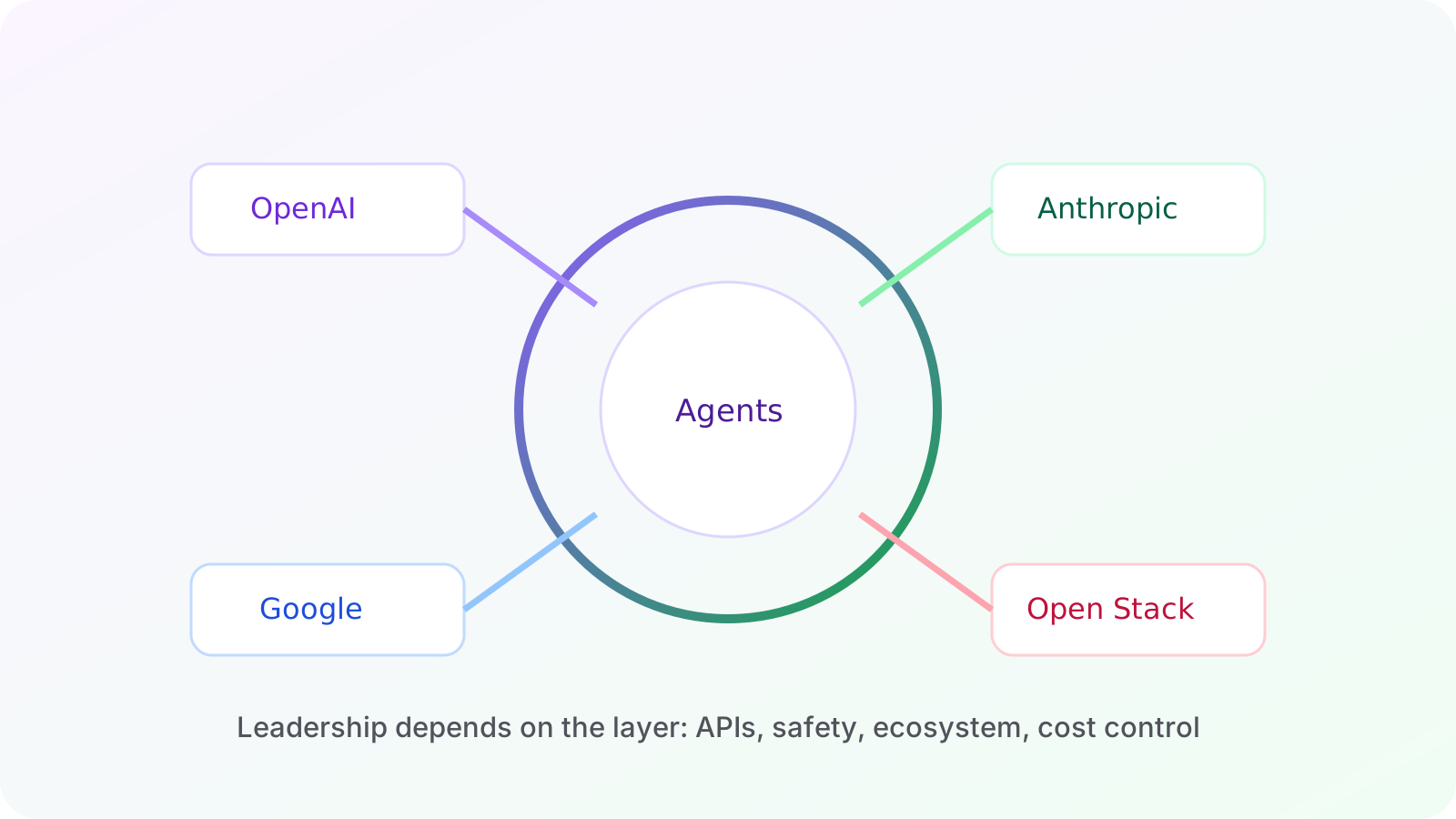
Agentic development has multiple layers, and different players lead different layers.
A practical way to evaluate leaders
I grade platforms on five dimensions:
- tool use reliability
- planning quality under constraints
- developer ergonomics
- safety and policy controls
- cost-performance at production volume
Current leadership by layer
1) Application API integration
OpenAI has been strong on integrated developer workflows, especially after the Responses API and tools updates in March 2025. If your team wants one cohesive path from prototype to production, this is attractive.
2) Constitution, safety posture, and enterprise trust language
Anthropic has led with clear positioning around constitutional alignment and explicit policy scaffolding. For teams in regulated or trust-sensitive contexts, this matters beyond raw benchmark scores.
3) Ecosystem breadth and distribution
Google keeps a distribution advantage across cloud, workspace, and developer channels. That matters if your product strategy depends on enterprise integration depth.
4) Open model leverage and customization
Open-model ecosystems (including fast-moving players in 2025) are strongest on cost control and architectural flexibility. You trade convenience for operational ownership.
What this means for a small product team
Do not ask “which model is best?” Ask “which stack gives us leverage on our bottleneck this quarter?”
| Team bottleneck | Likely better default |
|---|---|
| Fast shipping with small team | integrated closed-provider stack |
| Strong policy and controlled behavior | provider with explicit safety controls |
| Cost-sensitive high-volume workloads | mixed routing with open-model lane |
| Vendor risk concerns | multi-provider architecture from day one |
My current default
For user-facing assistants, I prefer:
- one primary provider for speed,
- one secondary provider for resilience,
- one open-model lane for cost and experimentation,
- shared eval harness across all three.
This avoids platform lock-in without slowing weekly shipping.
Bottom line
No single company “wins agents” in the abstract. Leadership depends on the layer you care about.
The durable advantage is not picking the right logo. It is building a system that can switch lanes without breaking user trust.