Emergence in the Plains: Horse Flocks, LLMs, and the Consciousness Question
What an overhead herd simulator reveals about local rules, global patterns, and why coherent behavior can appear without a central controller.
- Emergence
- Consciousness
- Simulation
- LLMs
- Complex Systems
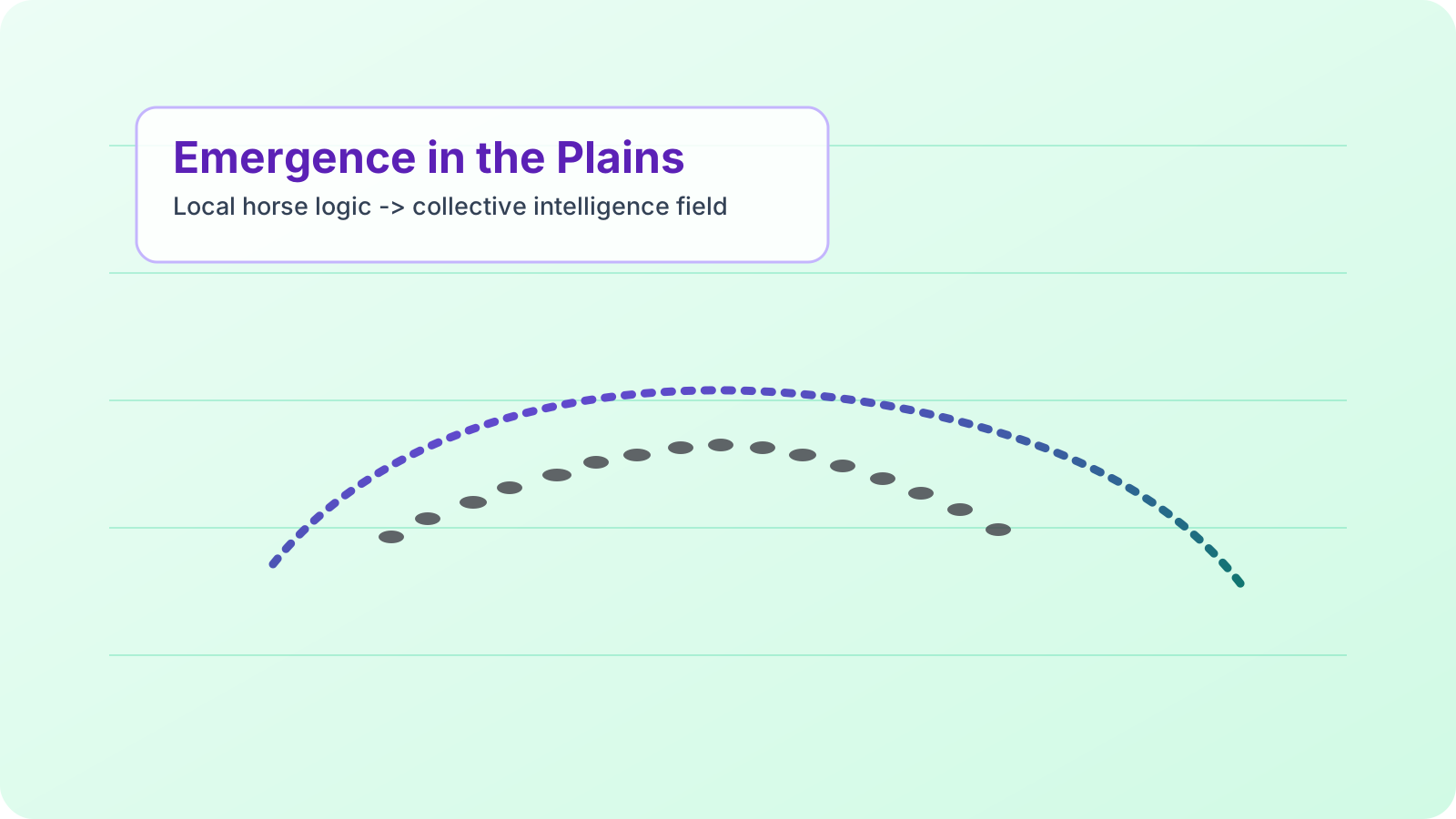
I built a Horse Flock Simulator as an art-and-systems study.
This 2026 iteration lands in Fire Horse year (火马, Huoma), which is why the live demo includes a Fire Horse toggle: same local rules, hotter visual signal.
You watch a herd from overhead on open green plains. Each horse has no global map and no “boss” node. It just follows local rules:
- do not collide,
- stay near neighbors,
- align heading with nearby movement,
- maintain a speed envelope,
- respond to local directional shifts.
Yet the group moves like a coordinated organism.
Why this matters
When people see coordinated motion, we reflexively infer centralized intelligence. But many coordinated systems are decentralized.
This simulator is a small reminder that coherence can be emergent, not commanded.
The bridge to brains
Neurons also operate through local interaction. No single neuron has the whole thought. But network dynamics can create perception, planning, memory, and self-modeling.
That does not prove a flock “is conscious” or that any distributed system must be conscious. It does show that global order can arise from local primitives.
The bridge to LLMs
Token-level processing in LLM systems is also local and distributed in structure. No single token, head, or layer “contains” the answer in full. But interaction across many units can produce behavior that appears strategic, reflective, or intentional.
Again, this is not proof of consciousness. It is evidence against naive reductionism.
Better framing: emergence with humility
I reject both lazy positions:
- “If it looks coherent, it must be conscious.”
- “If local units are simple, global behavior is trivial.”
A stronger framing is:
- local rules can generate non-trivial global behavior,
- global behavior can deserve serious analysis,
- ontology claims still require care.
What the simulator is trying to teach
The Horse Flock Simulator is not a claim that horses, neurons, or LLMs are “the same thing.” It is a visual argument:
Simple interacting agents can produce patterns that feel intentional from the outside.
That is exactly why consciousness debates in AI are hard. Mechanism can be clear while interpretation remains contested.
Practice takeaway for builders
When designing AI products, model local rules and interaction dynamics before making grand claims.
If you want trustworthy systems:
- specify local constraints,
- instrument emergent outcomes,
- separate behavioral performance from metaphysical conclusions.
That is both scientifically cleaner and product-wise safer.