Imperfect Humans, Perfect Simulacra
AI can approximate an idealized person at scale, but our limits, errors, and lived constraints are part of what make human meaning possible.
- AI Philosophy
- Simulacra
- Human Nature
- Meaning
- Future of Work
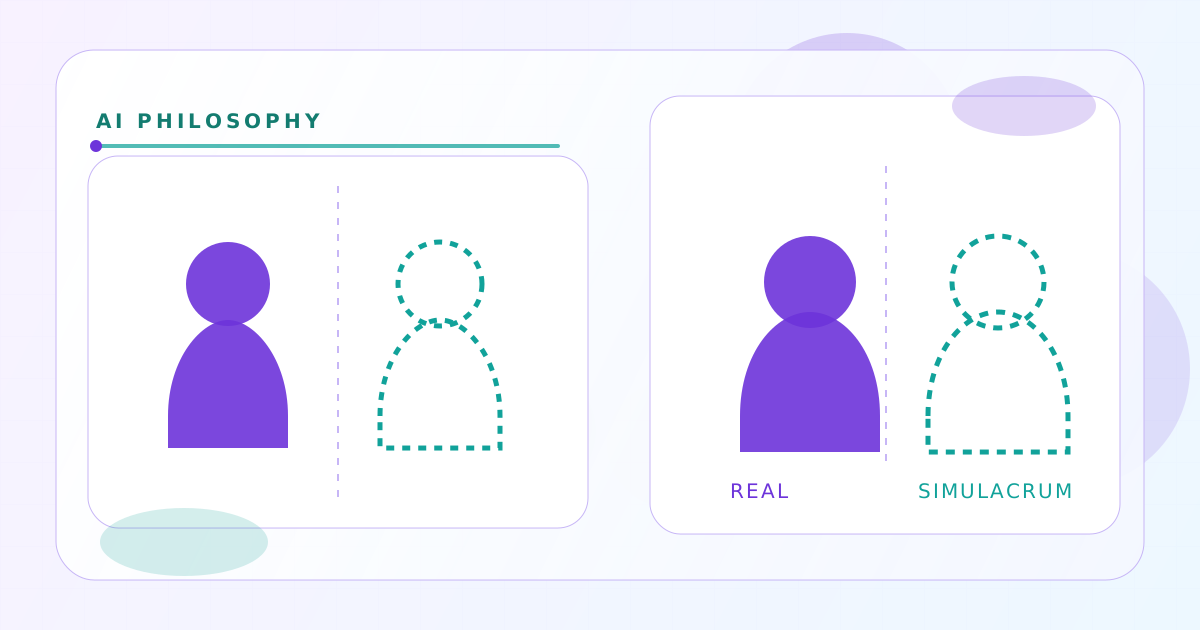
AI makes it possible to manufacture a very specific type of human approximation: articulate, consistent, always-on, rapidly editable, and often very convincing.
In many work contexts, this approximated person is economically superior:
- faster output,
- lower variance,
- lower maintenance cost,
- cleaner formatting,
- no sleep, no burnout, no social friction.
If your metric is only output quality per dollar, simulacra (AI-generated stand-ins for human work) will keep winning more tasks.
That part is straightforward.
Quick definitions (plain English)
- Simulacra: synthetic approximations of human output.
- Existentialism: a tradition in philosophy that argues people create meaning through choices and action.
- Authorship loop: who sets goals, accepts tradeoffs, and stays accountable for outcomes.
The non-straightforward part
A human being is not only an output generator.
A human life includes hesitation, contradiction, fatigue, grief, joy, care, conflict, reconciliation, memory, obligation, and mortality. The polished output is just one visible byproduct of a much messier process.
That mess is not a bug in humanity. It is the condition of humanity.
Why we still watch humans
Even if robotics gets better at technically perfect execution, people still care about human performance in domains like figure skating, hockey, and live music.
Why?
Because the significance is not only “what happened” but “who did it, under what constraints, with what risk, after what life trajectory.”
A robot can imitate the best human routine. But the original performance only became possible through a lived history of limits, mistakes, and recovery.
That history is part of the meaning.
Existentialism, with one corollary
Existentialism says humans create meaning.
I agree, and I would add a corollary for this era:
Humans also create meaning for machines.
Machines can generate outputs. They can optimize functions. They can assist, predict, and coordinate.
But the purpose of those operations is still assigned by human frames: social goals, ethical constraints, and civilizational priorities.
The machine does not wake up and decide what counts as a good life. We do.
The danger of idealized simulacra
A hidden risk in AI culture is that we start treating optimized simulation as morally prior to biological life.
You can see this in subtle defaults:
- preferring frictionless interaction over real relationship,
- preferring polished certainty over vulnerable truth,
- preferring machine-like consistency over human development.
That path quietly reframes people as defective versions of their own simulation.
I reject that framing.
Biological limits as identity, not defect
Our limits separate us from machines:
- finite attention,
- fragile bodies,
- emotional volatility,
- bounded lifespans,
- irreversible choices.
Those are constraints, yes. They are also the architecture of human significance.
A perfect system has no tragedy. A system with no tragedy has no courage. A system with no courage has no meaning in the way humans understand meaning.
Practical stance for builders
So what should we do with this?
- Use simulacra for leverage, not replacement ideology.
- Keep humans in authorship and accountability loops.
- Evaluate tools by whether they increase human agency.
- Design for dignity, not only throughput.
The goal is not to freeze progress. The goal is to keep progress pointed at human flourishing rather than human subtraction.
Final thought
I am not anti-machine. I build with these systems every day.
But I am pro-human on purpose.
If AI gives us an approximated ideal person, we should treat that as a powerful tool, not a new standard that biological people are expected to imitate.
Our inability to be machine-like is not a failure. It is exactly what makes us human.
Related notes:
- Simulacra, Reality, and Why I Am a Biological Chauvinist
- Revisiting Searle’s Chinese Room
- If AI Is Electricity, Agents Are Engines
Your imperfect human friend,
Oli
March 3, 2026