Prompting Guide for Real Products (Not Prompt Theater)
How to write prompts as contracts: role, goals, constraints, and failure behavior that hold up in production.
- Prompting
- AI Engineering
- Product
A lot of prompt advice sounds clever and performs terribly in production.
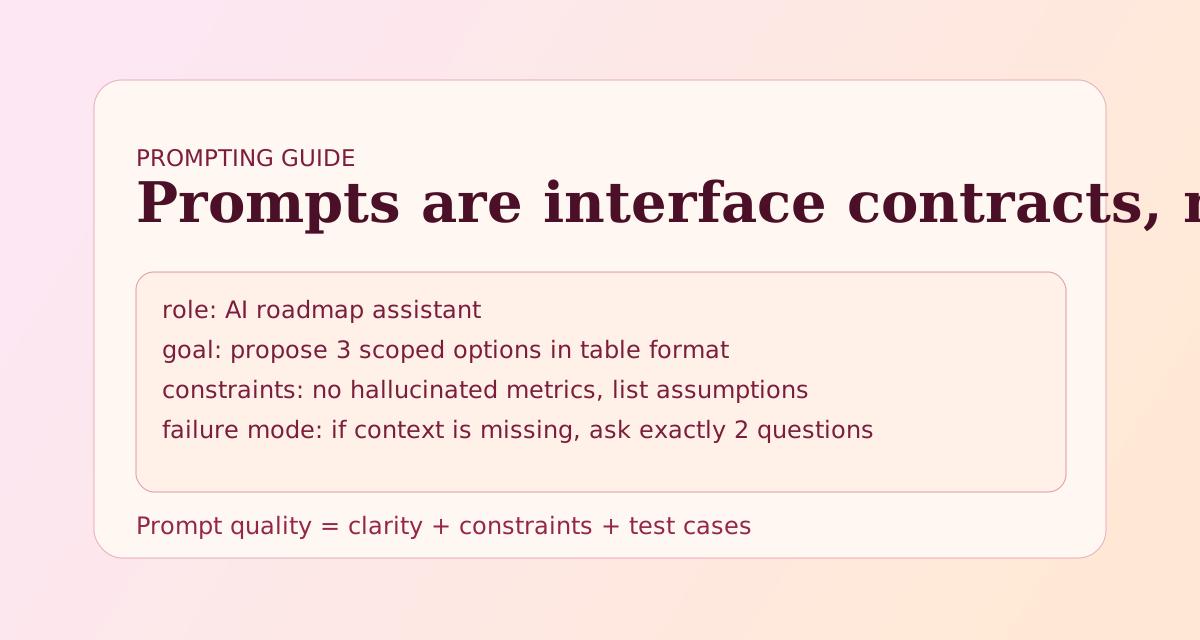
The core mistake: treating prompts as magic text instead of interface contracts.
Prompt quality is mostly specification quality
A strong production prompt usually makes these explicit:
- role
- objective
- allowed actions
- disallowed actions
- output format
- fallback behavior
If these are missing, your model is guessing your product intent.
The production prompt template I trust
SYSTEM:
You are {role} for {product context}.

GOAL:
Deliver {concrete outcome} for {user type}.

CONSTRAINTS:
- Do not invent facts, metrics, or citations.
- If required context is missing, ask exactly {N} clarifying questions.
- If confidence is low, return "uncertain" + reasons.

OUTPUT FORMAT:
Return markdown table with columns: {A, B, C}.
Keep response under {X} words.

QUALITY BAR:
- Specific
- Actionable
- Internally consistent
This is not pretty, but it is debuggable.
Prompt anti-patterns
-
Overloaded system prompts Trying to embed your whole strategy doc in one prompt hurts clarity.
-
No structural output requirements Free-form prose is hard to validate and diff.
-
Hidden assumptions If assumptions are not surfaced, reviewers can’t challenge them.
-
No graceful failure protocol You need a standard response shape for uncertainty.
Make prompt reviews part of engineering reviews
Treat prompt changes like logic changes.
My minimum checklist:
- What behavior changed?
- Which evals cover it?
- What regressions are likely?
- How do we roll back quickly?
Prompting and UX are one system
Prompt quality can’t compensate for bad UX scaffolding.
Give users:
- structured inputs
- clear examples
- explicit expected output
- confidence cues
The easiest way to improve prompts is often to improve the input surface.
The pragmatic conclusion
Stop chasing one perfect prompt. Build a prompt + eval + UX loop that improves every week.
That is how prompting becomes an advantage instead of a maintenance nightmare.