Revisiting Searle's Chinese Room in 2026
A practical philosophical stance on AI anthropomorphism, Turing-style behavior tests, and what they do and do not prove.
- Philosophy
- Anthropomorphism
- Turing Test
- AI Strategy
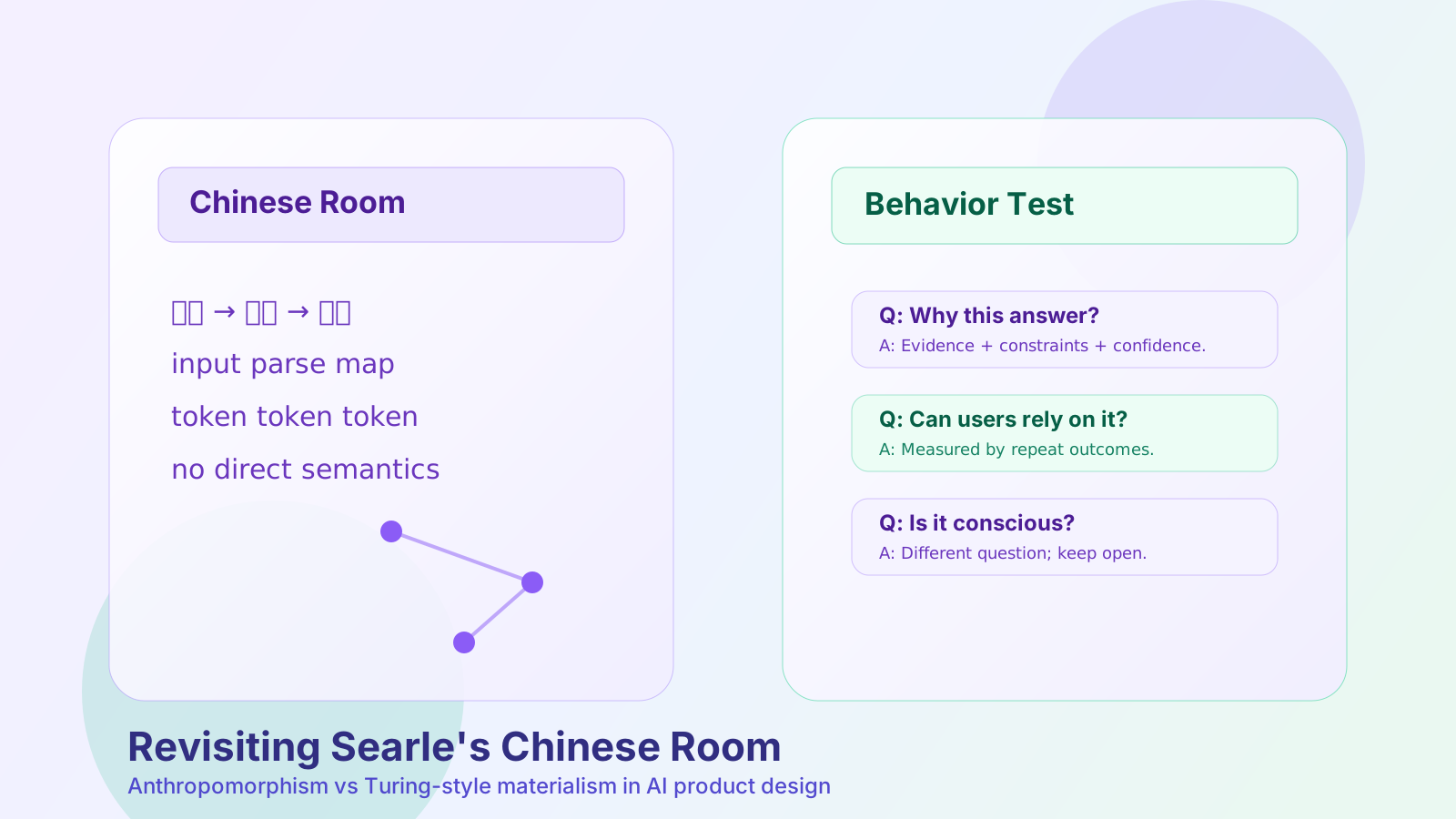
The Chinese Room argument still matters. Not because it “defeats AI,” but because it forces precision about what kind of claim we are making.
John Searle died on September 17, 2025, and his argument remains a useful diagnostic for AI claims.
Searle’s point was narrow and sharp: symbol manipulation alone does not automatically imply understanding. That is still a useful warning in 2026.
The confusion I keep seeing
People collapse three different questions into one:
- Can the system produce fluent behavior?
- Does the system understand in the same sense humans understand?
- Should we treat the system as a social actor?
These are related, but they are not equivalent.
Anthropomorphism vs behaviorism
Anthropomorphism
Anthropomorphism is a UI and language habit: we project minds onto systems that look conversational. It is often useful for onboarding and often dangerous for judgment.
Typical failure modes:
- users over-trust confident language
- teams under-specify guardrails because the model “seems smart”
- product decisions drift from evidence to vibes
Turing-style behaviorism/materialism
At the other extreme, a strict behavioral stance says: if a system is functionally indistinguishable in relevant contexts, that is enough for attribution of intelligence.
This stance is strong in modern AI engineering because it maps to measurable outcomes:
- task completion
- error rates
- reliability under constraints
- adaptability over repeated use
I use this stance for product evaluation. I do not assume it settles metaphysics.
What the Chinese Room still gives us
The argument does not tell us to stop building. It tells us not to confuse:
- output quality with ontology,
- simulation of understanding with proof of understanding,
- social fluency with moral status.
That distinction is operationally important.
A practical framework I use
I run AI product decisions on three separate tracks.
| Track | Core question | Standard |
|---|---|---|
| Product track | Does it help users do the job? | Behavioral evidence and outcome metrics |
| Epistemic track | What can we honestly claim it “understands”? | Conservative language and explicit limits |
| Moral track | What obligations apply to this system? | Open question, handled with caution |
Most teams only run the first track. That is why anthropomorphism sneaks into copy, UX, and policy decisions.
My stance
I reject two lazy positions:
- “It’s basically a person” (naive anthropomorphism)
- “It’s only autocomplete, so nothing matters” (dismissive reductionism)
The middle position is harder and more useful:
- evaluate systems by behavior for product decisions
- avoid person-language that implies unearned ontology
- design clear accountability for failure and recovery
Why this matters for builders
If you are shipping AI products, your words shape user mental models. Mental models shape trust, and trust shapes risk.
So this is not abstract philosophy. It is product quality work.
The best teams I know are explicit:
- what the model is doing,
- where it is uncertain,
- who is accountable when it is wrong.
That is how you get both velocity and intellectual honesty.