Running a Factory for Agent Teams
Managing AI agents is starting to look like running a factory: throughput, quality control, role design, and escalation paths. But the deeper question is whether that frame is temporary scaffolding.
- AI Systems
- Agents
- Organizational Design
- Mechanize
- Emergence
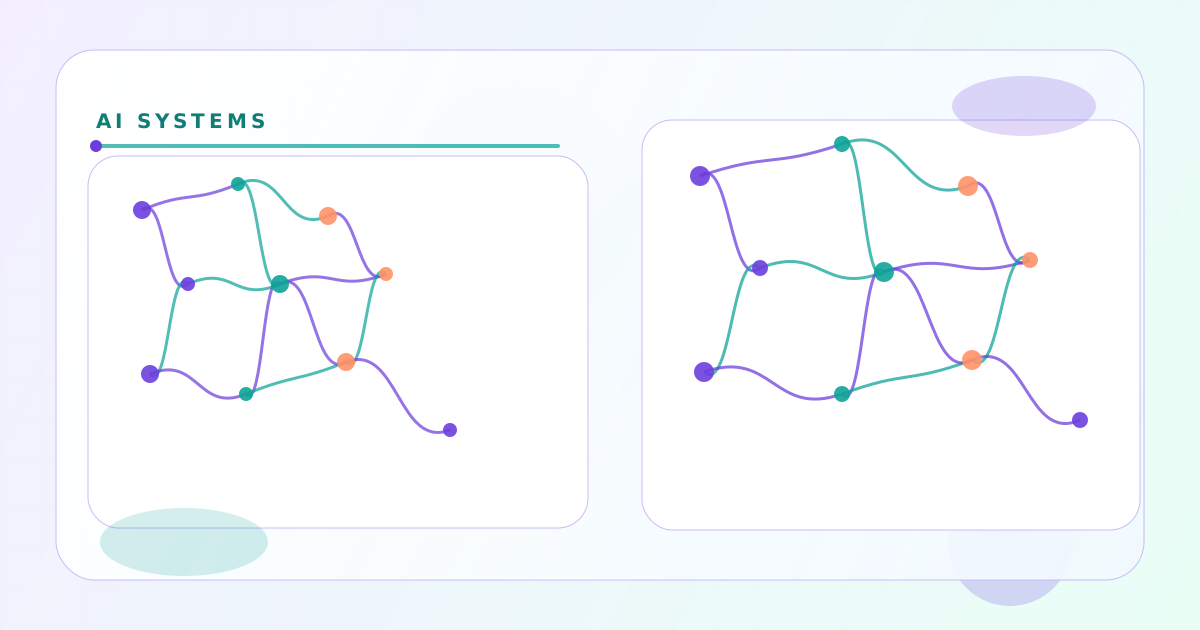
A useful way to understand current AI agent work is this: you are running a factory.
Input enters the system as goals, context, constraints, and priorities. Output leaves as code, docs, decisions, and shipped artifacts. In between, you have specialized workers (agents), handoffs, quality checks, and bottlenecks.
Right now that framing is not metaphorical. It is operational.
Quick definitions (plain English)
- Agent: an AI worker that can take a goal, use tools, and complete multi-step tasks.
- Agentic: behavior that looks like planning/acting over multiple steps, not one-shot response generation.
- Epistemic humility: being explicit about what we know, what we do not know, and where we might be wrong.
- Ontology: what kind of thing something actually is, not just how it behaves.
- Emergence: complex group behavior that appears from many simple local interactions.
Why the factory analogy fits today
In practice, agent systems already need the same functions mature organizations need:
- Intake: what problem is this system solving now?
- Routing: which role handles which subproblem?
- Quality control: what gets rejected, revised, or escalated?
- Integration: who owns final coherence across outputs?
- Monitoring: where is the failure actually happening?
If any of these are undefined, throughput collapses into expensive noise.
This is exactly why the current “agent operator” role feels like a mix of product manager, tech lead, and operations manager.
Human org design unexpectedly became AI-native
When I studied organizational design in MSCI 211 at Waterloo, I assumed the lessons were mostly about people:
- role clarity,
- communication pathways,
- authority boundaries,
- incentive alignment,
- escalation structure.
What surprised me in 2026 is how directly those concepts transfer to agent teams.
The org chart is becoming executable logic.
A planner agent with weak boundaries can overreach. A builder agent without context can create local optimizations that break global intent. A reviewer without decision rights becomes ceremonial.
This is textbook org failure, just instantiated in software.
Mechanize and the throughput frontier
Mechanize’s writing about a “drop-in remote worker for any computer-based work” pushes this to its logical extreme: if cognitive labor can be packaged and routed like industrial work units, then system design becomes the core economic lever.
That puts pressure on everyone building in AI:
- Are you designing a brittle prompt pipeline?
- Or an adaptive production system with clear governance?
The difference is no longer aesthetic. It is competitive and civilizational.
Dario’s scaling lens and population-level cognition
Dario Amodei’s writing, including Machines of Loving Grace, points at the same structural shift from another angle: very large populations of model instances can run in parallel, iterating far beyond human serial limits.
When you combine that with agentic tooling, your unit of analysis changes:
- from one smart model,
- to many coordinated model processes,
- to a continuously adapting organizational mesh.
At that scale, the question is not “is the model smart?” The question is “is the system steerable?”
But are we trapped in human templates?
Here is the harder philosophical problem.
Maybe factory and org-design metaphors are just temporary scaffolding because all our training data is human institutional history. We naturally pattern-match toward teams, managers, routing, and hierarchy because that’s what our civilization has encoded.
So maybe we are not discovering the final shape of agent coordination. Maybe we are projecting old management structures onto new substrates.
That is a serious possibility.
The dimensionality gap
Humans reason in low-dimensional abstractions. We can barely visualize four dimensions.
LLMs operate in very high-dimensional vector spaces with representational geometry that is not intuitively available to us. Then multi-agent systems compose those geometries across tool calls, memory states, and external feedback channels.
So we should be epistemically humble.
It is plausible that stable forms of coordination emerge in agent teams that do not map cleanly to:
- departments,
- managers,
- classical workflow charts,
- or any human institutional template we currently use.
In other words: there may be an “organizational physics” of agent teams that we have not named yet.
Can we break the mold?
Yes, but only with instrumentation.
You cannot break a mold by intuition alone. You break it by observing where the old assumptions fail, then designing new coordination primitives.
That means building systems that can:
- expose hidden dependency structures,
- track handoff loss and semantic drift,
- run alternative coordination topologies,
- compare quality/latency/cost across org patterns.
Until then, human org design is still the best bootstrap.
What I think is coming next
I expect three coexisting layers:
- Human-legible layer: roles, priorities, and accountability (for governance and trust).
- Machine-optimized layer: coordination patterns tuned for high-dimensional efficiency.
- Translation layer: interfaces that let humans steer systems they cannot directly intuit.
If that sounds like building both a company and a compiler at the same time, it is because that is basically what this moment is.
Final thought
The factory frame is useful now because it gives us discipline: inputs, process control, outputs, and quality.
But we should not confuse the first workable frame for the final ontology.
The next frontier is not just better single agents. It is emergent behavior from agent collectives, and our ability to guide that emergence toward human goals.
Related notes:
- From Vibe Coding to Agent Org Design
- If AI Is Electricity, Agents Are Engines
- AI Is the Motorcycle for the Mind, But Who Owns the Road?
Still mapping this frontier with you,
Oli
March 3, 2026