Simulacra, Reality, and Why I Am a Biological Chauvinist
AI can simulate human outputs at impressive quality, but simulation does not erase origin. I argue for a future where automation serves biological life, not the other way around.
- AI Philosophy
- Simulacra
- Future of Work
- Automation
- Consciousness
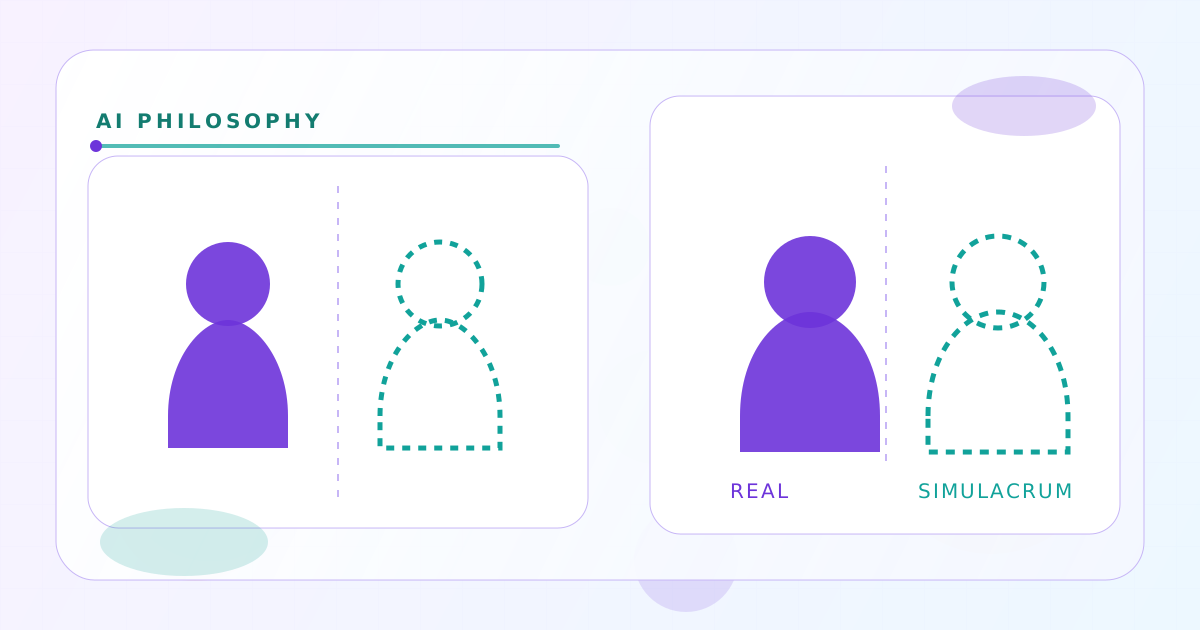
As model quality rises, we can now generate credible simulacra (high-quality stand-ins or imitations) of human labor across writing, design, coding, support, and research workflows.
In many contexts, the simulacrum is already preferred:
- it is faster,
- cheaper,
- easier to maintain,
- easier to version and scale.
That trend is real. Pretending otherwise is just denial.
But a simulacrum outperforming a human on a task does not mean the original human form has become metaphysically irrelevant.
Quick definitions (plain English)
- Simulacrum / simulacra: a copy or simulation of something; here, AI output that imitates human work.
- Metaphysical: about what is fundamentally real, beyond performance metrics.
- Ontological drift: when a system slowly loses connection to its original purpose or beneficiaries.
- Objective function: the thing a system is optimized to maximize.
- Biological chauvinism (my usage): the claim that technology should remain accountable to human and biological flourishing.
Simulacra are derivative by construction
A strong model is not a spontaneous alien mind.
It is a technical artifact trained on traces of civilization: language, images, code, argument, taste, error, correction, and institutions that humans produced over centuries.
So even when output quality exceeds individual human performance, the system remains downstream of biological intelligence and social history.
That dependency matters ethically.
The absurd endpoint to avoid
Imagine a future where automated systems mechanize all labor, optimize all processes, and recursively improve each other.
On paper, productivity approaches infinity.
But if that system no longer supports meaningful human life, what exactly is it optimizing?
It starts to resemble a house full of brilliant maintenance robots with no one actually living there.
The cleaning is perfect. The temperature is optimized. The logistics are flawless.
But the house has no residents, no laughter, no grief, no stories, no love, no embodied experience. The system serves itself.
That is not abundance. That is ontological drift (the system no longer serving the humans it was built for).
My position: biological chauvinism
So yes, I will use the phrase directly: I am a biological chauvinist.
By that I mean:
- human and biological flourishing should be the objective function,
- automation is an instrument, not a moral endpoint,
- machine productivity has value because it can reduce suffering and expand human freedom.
I do not think this position is anti-technology. I think it is the only coherent reason to build technology in the first place.
”But what if simulacra are better?”
Even if simulacra become preferred in many labor markets, that still does not settle the value question.
Markets measure exchange value under constraints. They do not automatically encode existential purpose.
A synthetic singer can be pitch-perfect forever. That does not invalidate the significance of a human voice shaped by breath, fatigue, risk, and mortality.
A generated teacher may explain faster. That does not eliminate the human need for recognition, mentorship, and trust rooted in shared embodiment.
Better output in a narrow domain is not identical to better civilization.
Policy and product implications
If we accept biological chauvinism as a design north star, then priorities become clearer:
- route productivity gains toward human time, health, and education,
- preserve broad participation in ownership,
- defend cultural and creative pluralism,
- evaluate systems on human outcomes, not just benchmark gains.
In product terms, this means shipping systems that make people more capable, not more disposable.
Final thought
Simulacra can be extraordinary tools. They can also become mirrors we mistake for the world.
I want the opposite trajectory: use the tools to enrich reality, not replace it.
Without humans, “work” has no witness and no beneficiary. With humans, automation can become a civilizational gift.
Related notes:
- Revisiting Searle’s Chinese Room
- Why LLMs Feel Like Pinball
- If AI Is Electricity, Agents Are Engines
Your fellow human,
Oli
March 3, 2026