Why UX Still Matters in the Age of Strong Models
Model quality improved fast, but bad UX still kills adoption. The interface is where trust, clarity, and repeat usage are won or lost.
- UX
- AI Product
- Product Strategy
- Behavior Design
Models got better. That part is real.
But if you zoom out from benchmark charts and look at actual product usage, one thing is still true: people do not adopt model quality. They adopt experiences.
I see teams confuse these layers all the time:
- model capability
- product behavior
- user trust
They are related, but not interchangeable.
Better models do not fix unclear interaction design
You can have a great model and still ship a bad product if users cannot answer basic questions fast:
- What is this tool for?
- What should I type here?
- What does this output mean?
- What should I do next?
If those answers are not obvious, users bounce. Not because the model is weak, but because the interface asks them to do product design work in real time.
UX is the control plane for AI
When I say UX, I do not mean visual polish first. I mean decision architecture:
- how intent is captured
- how scope is constrained
- how uncertainty is represented
- how recovery works when outputs are wrong
This is especially important in AI because outputs are probabilistic. Without good UX, people read confidence where there is only fluency.
Trust is an interface outcome
Users trust systems that are predictable and inspectable.
That means:
- show what the system considered
- show confidence without fake certainty
- give one-click correction paths
- preserve user agency on final decisions
If your interface hides uncertainty and forces users to reverse-engineer failures, trust collapses even if answer quality is “technically good.”
The repeat-use test
The real test is not “did it look impressive in demo week.” The real test is “did the same person come back and complete the same job faster next time.”
Repeat usage is mostly a UX problem:
- reduced decision fatigue
- lower correction cost
- clearer mental model
Strong models help, but UX determines whether that model strength turns into retained behavior.
Practical rule I use
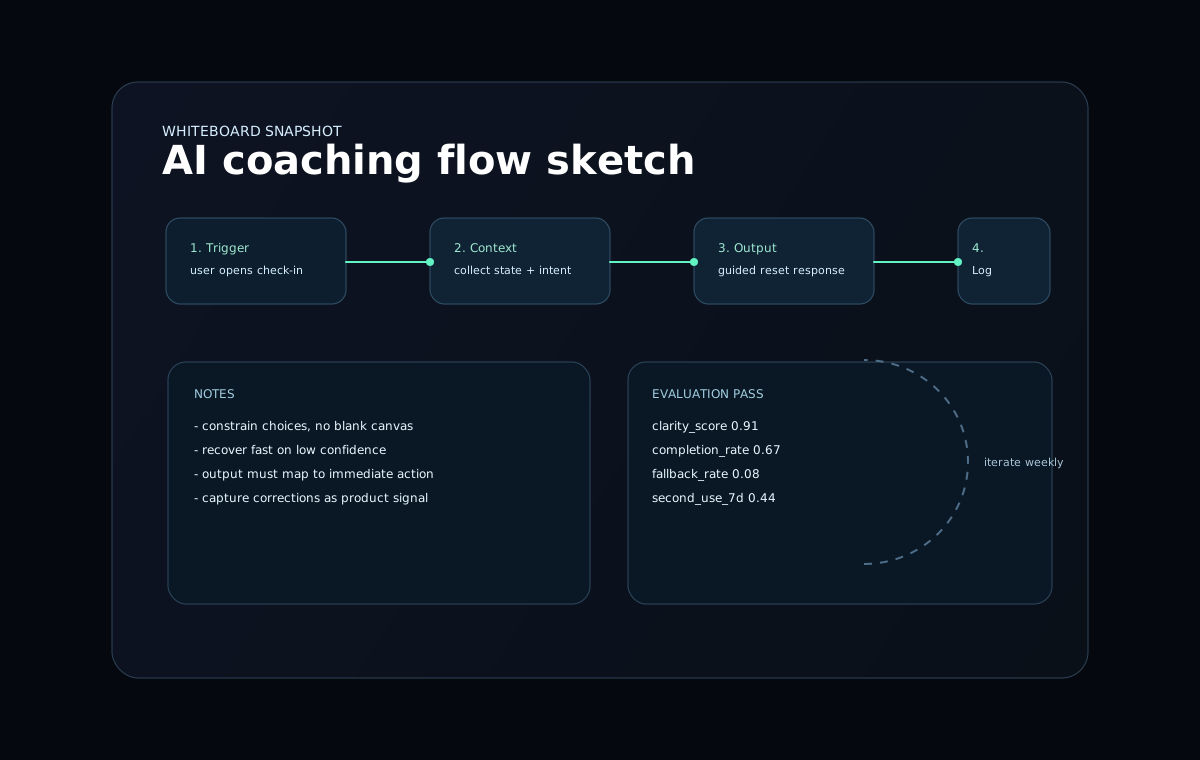
Design the interaction loop before optimizing prompts.
- Define the user job and done condition.
- Constrain input and output shape for that job.
- Add visible fallback states.
- Measure second-use completion rate.
After that, model upgrades compound nicely.
Before that, model upgrades just make better-looking chaos.
Bottom line
The model is the engine. UX is the steering wheel, dashboard, and brakes.
Without UX, capability is mostly latent potential. With UX, capability becomes reliable behavior change.
Your friend, Oli — Oliver Cheng | March 2, 2026