DeepSeek-R1 and the Open-Model Cost Shock
What DeepSeek-V3 and R1 signaled about capability, inference economics, and the next competitive layer for AI products.
- DeepSeek
- Open Models
- Inference Cost
- Competition
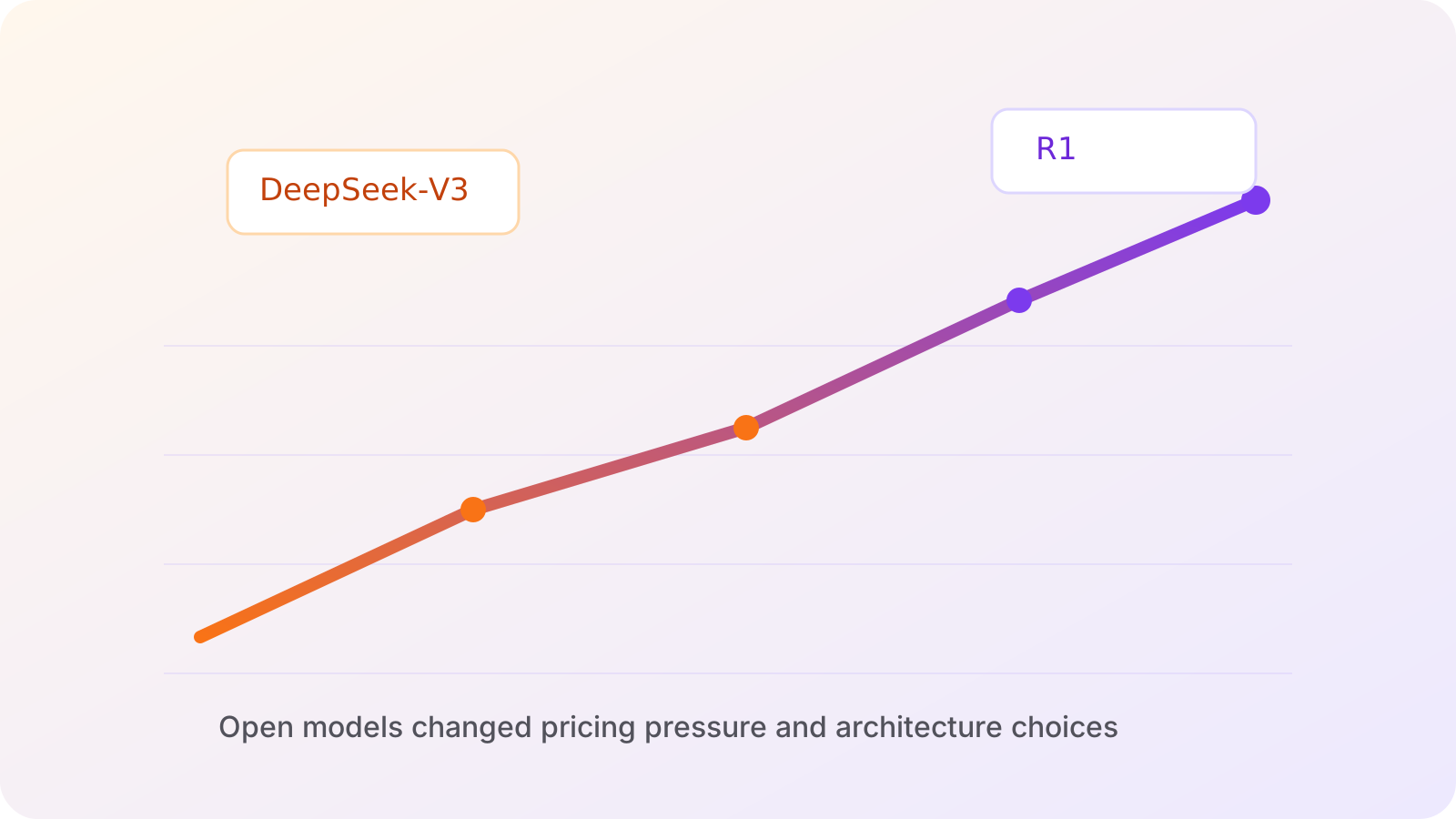
DeepSeek changed the conversation in two steps:
- DeepSeek-V3 (late December 2024) showed serious open-model competitiveness.
- DeepSeek-R1 (January 2025) pushed reasoning performance and forced a cost conversation.
The important part is not “who won a benchmark this week.” The important part is market structure.
What shifted
Before this wave, many teams assumed frontier quality was tightly coupled to frontier pricing. DeepSeek compressed that assumption.
Now teams can combine:
- stronger open-weight reasoning options,
- aggressive hosting and routing strategies,
- and product-level guardrails for reliability.
That moved the bottleneck from model access to product execution.
What this means for builders
I see four direct implications:
-
Provider monoculture is a strategic risk. Routing across model tiers is now table stakes.
-
Inference cost is a product feature. Lower cost means more generous retries, memory checks, and safer fallbacks.
-
Evaluation quality matters more than branding. If your evals are weak, you will pick providers by vibes.
-
Latency and reliability become differentiators again. Capability parity pushes competition into operations.
The part people miss
Cheaper capable models do not automatically mean better user outcomes. They mean you can afford better product loops.
Use the budget delta for:
- defensive re-ranking,
- contextual verification,
- human review on high-risk actions,
- and richer telemetry.
That is where durable advantage comes from.
My strategy after DeepSeek-R1
For any user-facing feature, I now design around three model lanes:
| Lane | Role |
|---|---|
| Fast lane | low-cost first draft and lightweight transforms |
| Reasoning lane | hard decisions and structured synthesis |
| Safety lane | policy checks, sensitive content gating, fallback |
This architecture is not tied to one vendor. That is the point.
Bottom line
DeepSeek-R1 was not just a model event. It was a pricing-and-power event.
The winners are the teams that treat models as modular infrastructure and put their real edge in UX, evals, and execution speed.