My Engineering Philosophy for AI Products
The principles I use to keep AI systems readable, reliable, and fast enough to ship every week.
- Engineering
- AI Systems
- Philosophy
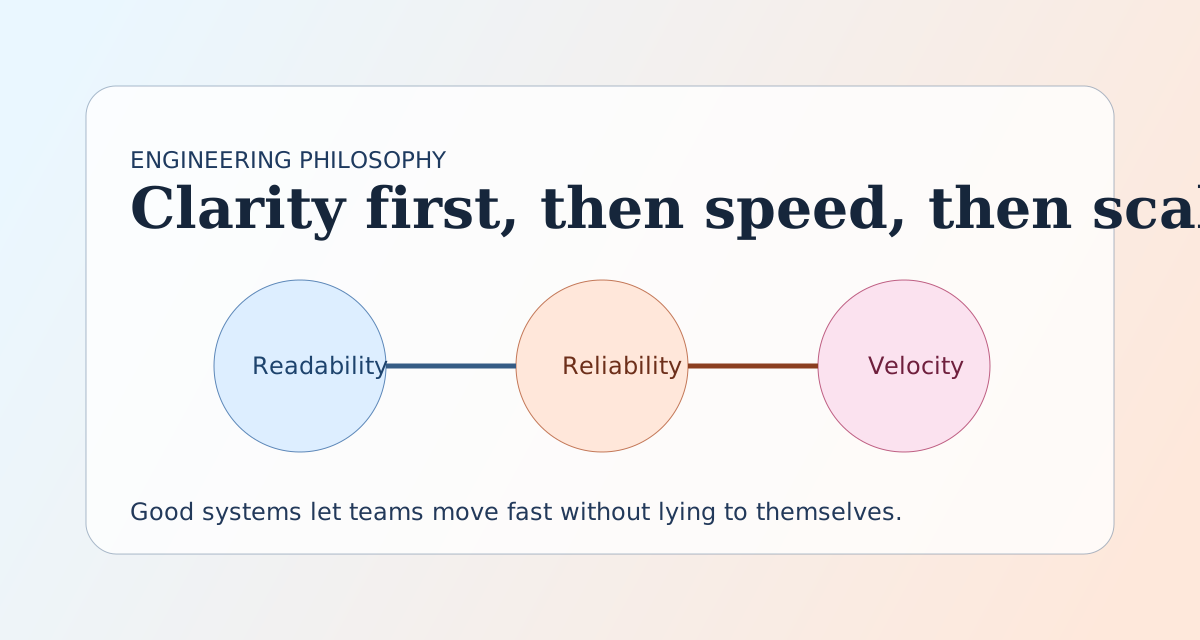
My default hierarchy is simple:
- Clarity
- Reliability
- Velocity
Most teams accidentally invert this under pressure.
1) Clarity: if nobody can reason about it, it’s already slow
AI codebases get messy quickly because behavior is partly data, partly prompts, partly runtime policy.
I optimize for:
- explicit boundaries (input shaping, model call, post-processing)
- typed output contracts where possible
- visible assumptions and fallback paths
Clean architecture is not style points. It is incident prevention.
2) Reliability: design for bad days, not good demos
AI systems fail in weirder ways than deterministic systems.
I assume:
- upstream model changes
- intermittent latency spikes
- malformed outputs
- rate/quotas constraints
So I add:
- retries with guardrails
- timeout budgets
- schema validation
- sane fallback responses
Users remember how your product behaves when it fails.
3) Velocity: speed with legibility
Shipping speed is not about heroics. It is about reducing decision drag.
The most useful patterns I’ve found:
- thin vertical slices
- explicit acceptance criteria
- one source of truth for evals
- instrumentation before scale
The goal is not to be “fast once.” The goal is to be predictably fast.
What I avoid
- premature multi-agent complexity
- giant internal frameworks nobody asked for
- hidden prompt mutations in random files
- metrics dashboards with no product interpretation
What I optimize for in teams
I want teammates to answer quickly:
- what changed?
- why did it change?
- how do we know it improved?
- how do we revert if needed?
If these questions are easy, delivery quality compounds.
The rule I come back to
Write code so future you can debug it at 2:13 AM with incomplete context.
That is the standard.