Philosophy of Personal AI Assistant
The personal assistant project is built as an adaptive interface scaffold: fast iteration, explicit constraints, and durable architecture.
- Personal Assistant
- Assistant UX
- Product Architecture
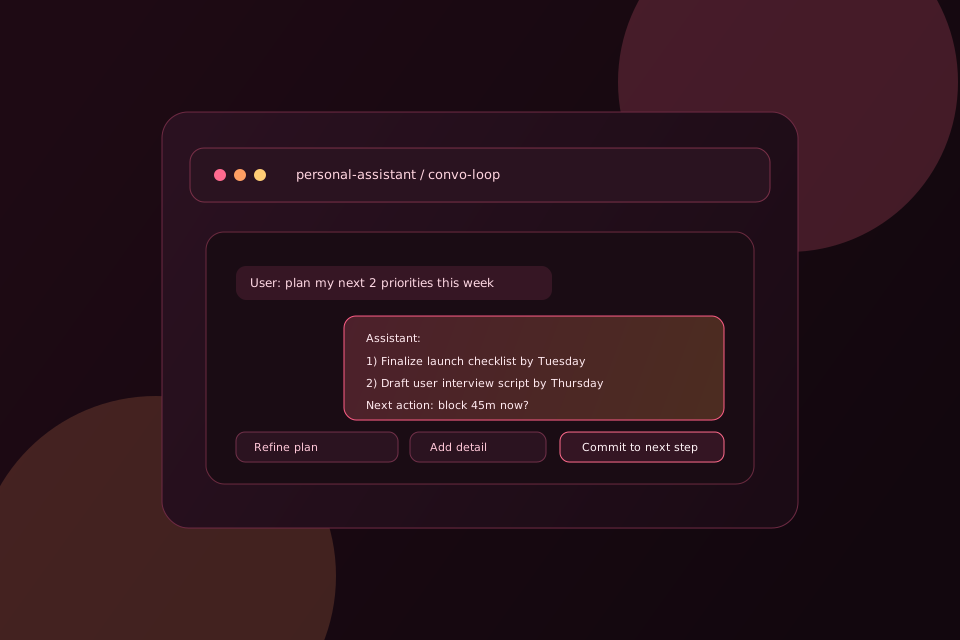
Personal AI Assistant (OPA: Oli’s Personal Assistant) is designed as a living system, not a fixed app.
A lot of assistant products are treated like one-time launches: prompt locked, UI locked, then incremental polish. That misses how assistants actually create value. Assistant quality is discovered through repeated use, edge-case friction, and evolving user goals.
Core stance
- Assistant value emerges through iteration, not declaration.
- Constraint design matters as much as model quality.
- Architecture should make behavioral changes safe and fast.
Why this framing matters
The hard part of assistant UX is not getting a fluent first response. The hard part is sustaining usefulness over weeks.
That requires product-level decisions about memory boundaries, escalation paths, and how much autonomy is appropriate for each task. If those decisions are vague, the assistant feels impressive in demos but brittle in real life.
Product consequence
The OPA codebase favors modular interaction primitives:
- reusable conversation scaffolds
- adjustable response style controls
- explicit fallback handling
- easy prompt/runtime updates without rewiring the whole interface
This architecture supports rapid iteration while limiting regressions.
Practical trust rule
The assistant should be clear about what it can do, what it cannot do, and where human judgment stays primary.
When assistants overclaim, trust collapses quickly. When assistants are explicit about constraints and provide usable next steps anyway, trust compounds.
Bottom line
The goal is not to build a “perfect assistant.” The goal is to build an assistant operating system that improves continuously with real usage.
In that sense, OPA is less a feature and more an ongoing product discipline: constrained autonomy, measurable outcomes, and iteration loops tight enough to keep pace with both model changes and user needs.
Best,
Oli
January 20, 2026