Oli Cheng 1 min read Methodology
Lean Methodology for AI Products
How I run lean loops for AI features: define, build, measure, and decide without fake certainty.
- Lean
- Product Strategy
- Execution
Lean in AI is not “ship random things fast.” It’s disciplined uncertainty reduction.
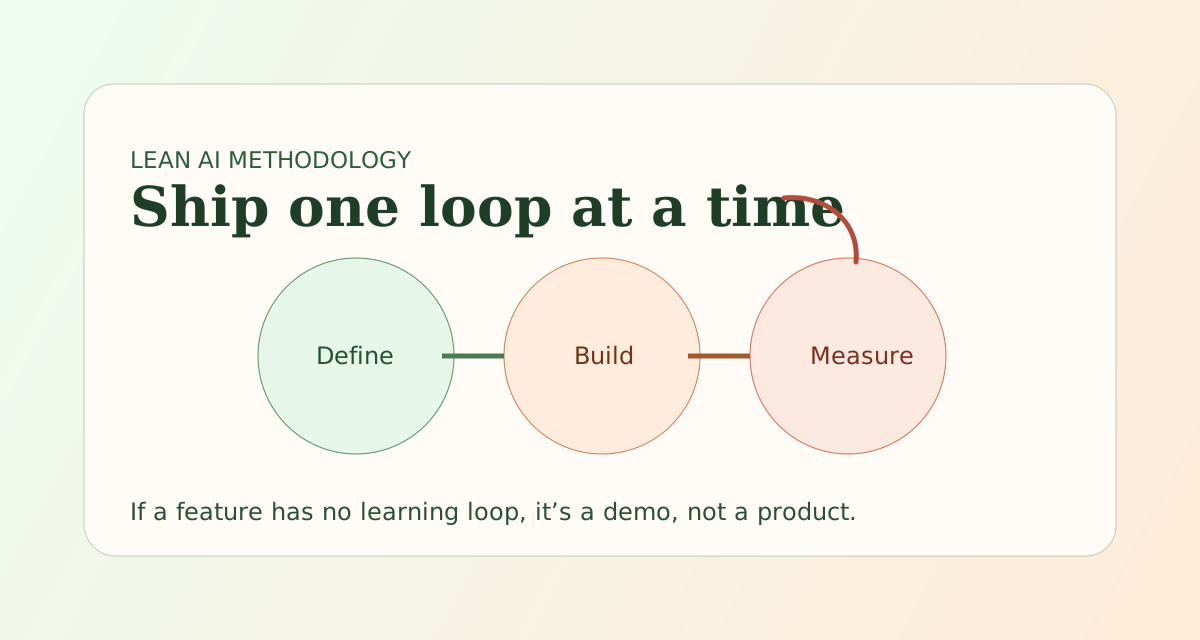
The loop I use
- Define one behavior change you care about
- Build the smallest complete path to test it
- Measure repeated usage + outcome quality
- Decide whether to expand, revise, or kill
This sounds basic. It is also where most teams drift.
What makes AI lean loops different
Compared with normal product loops, AI adds:
- output variability
- policy risk
- cost/latency tradeoffs
- harder quality interpretation
So your loop needs explicit evals and guardrails from day one.
The “one-loop rule”
For each sprint, choose one dominant loop:
- intake -> generation -> user action
- input -> recommendation -> adoption
- request -> automation -> review
If your sprint has 4 loops, learning quality degrades fast.
Metrics that matter
I care about:
- repeat engagement on AI-assisted flow
- completion rate after AI output
- correction rate (how often users rewrite/fix output)
- time-to-useful outcome
I care less about vanity metrics like total generated tokens.
Kill criteria are healthy
Every experiment should include an exit rule.
Example:
- If correction rate stays >40% after two iterations, stop scaling.
- If retention delta is flat after three cohorts, revisit problem framing.
This saves teams from sunk-cost optimism.
Lean posture for senior teams
A mature lean posture is:
- humble on assumptions
- strict on instrumentation
- fast on iteration
- unemotional on feature cuts
AI rewards teams that learn quickly, not teams that narrate convincingly.