Anthropic vs OpenAI Right Now: Technical Depth vs Generalist Reach
As of April 28, 2026, both companies can do a lot. The more interesting difference is where each seems to think the center of the product universe is: Anthropic around technical workflows and OpenAI around a broad general assistant, especially voice and multimodal surfaces.
- Anthropic
- OpenAI
- AI Platforms
- Voice
- MCP
- AI Product
As of April 28, 2026, I think the useful comparison between Anthropic and OpenAI is no longer “which one has the smarter model?”
That question changes too often, and the answer depends too much on the task.
The more stable question is:
What kind of world does each company seem to think AI should live in?
Right now, my read is:
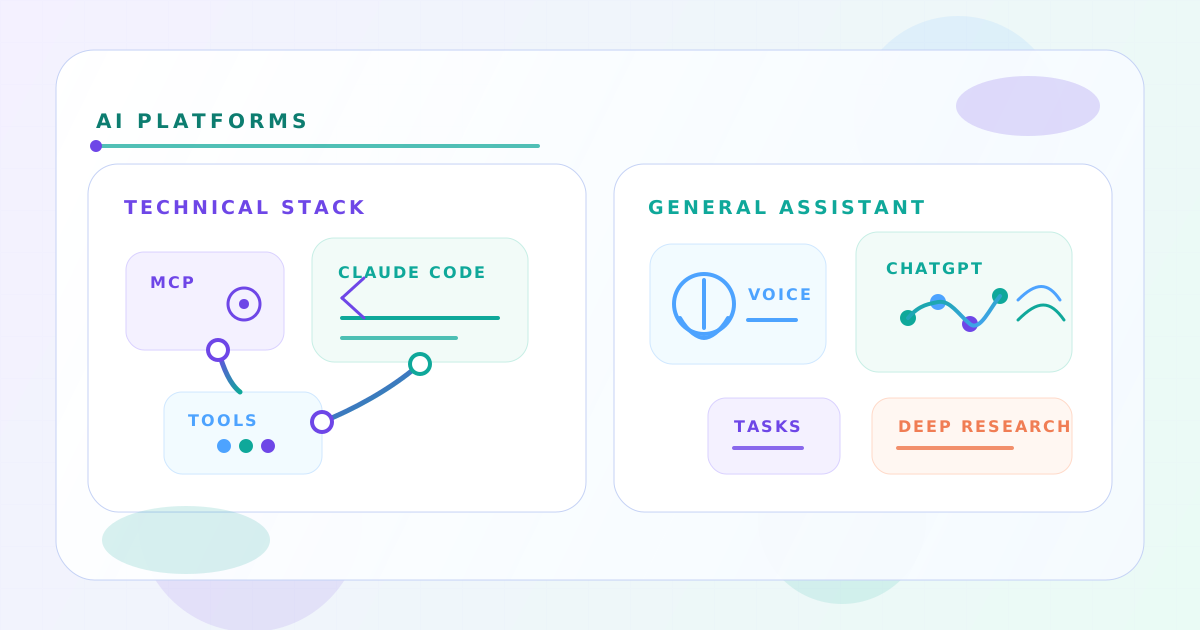
- Anthropic is leaning into the technical stack: coding, tool use, integrations, MCP, and serious workflow depth.
- OpenAI is leaning into the broader general assistant surface: multimodal chat, voice, research, automation, image generation, and products that want to feel like one assistant for many contexts.
That is a leaning, not a clean split. Both companies overlap a lot now. But the center of gravity feels different.
First, the overlap is real
It would be sloppy to pretend Anthropic is only for developers or OpenAI is only for consumers.
That is not true anymore.
Anthropic has:
- Claude Integrations built around remote MCP servers
- Claude Desktop Extensions, which make local tool and MCP setup much easier
- computer use, which gives Claude a real desktop-control surface
- voice mode on Claude mobile
- web search and connected workspace tools through Claude
OpenAI has:
- Codex, including its dedicated app workflow for delegated engineering work
- the Responses API with built-in tools and remote MCP support
- the Realtime API for production voice agents
- ChatGPT voice on web and mobile
- image generation directly in ChatGPT
- Tasks and Deep Research
So this is not a story about one side being capable and the other not.
It is a story about product emphasis.
Why Anthropic feels more technical right now
Anthropic’s product language still feels like it is speaking first to people who build systems.
The clearest signals:
1. MCP came from Anthropic
Anthropic introduced the Model Context Protocol in late 2024 as an open standard for connecting assistants to tools and data.
That matters not just technically, but philosophically.
It says: the future assistant is not interesting because it knows everything in isolation. It is interesting because it can plug into real systems cleanly.
Anthropic later donated MCP into the Agentic AI Foundation, which reinforces the sense that they want to shape the plumbing layer of the ecosystem, not just the chat layer.
2. Claude Code is not a side project
If you read Anthropic’s own Claude Code product page, the message is pretty direct.
This is not “Claude, but also maybe coding.” This is Anthropic treating coding and agentic software work as a primary arena.
The framing is very explicit:
- read the codebase
- make changes across files
- run tests
- monitor CI
- commit fixes
That is a much more operational and technical product identity than a general-purpose chat surface.
3. Even Anthropic’s broader assistant story routes through integrations and tools
Claude’s Integrations announcement is also revealing.
When Anthropic expands the consumer-facing product, it still does so in a way that smells like systems architecture:
- remote MCP servers
- connected tools
- long-running research
- workspace context
The assistant becomes more useful by getting attached to infrastructure.
That is a different instinct from “make the assistant more universally present in everyday life.”
4. Anthropic does have real product chrome around Claude
I do not want to flatten Anthropic into “just the backend company.”
Claude now has a real product shell around it:
- mobile voice,
- web search,
- a desktop app,
- Desktop Extensions,
- and computer use.
So the point is not that Anthropic lacks user-facing surface area.
It is that the surface area still feels oriented toward helping Claude connect to tools, systems, and bounded workflows rather than toward becoming the single default assistant across every everyday modality.
Why OpenAI feels more generalist right now
OpenAI still builds strong developer tools. That part is real.
But the overall product surface feels much broader and more assistant-like in the everyday sense.
1. OpenAI is going hard on voice
The simplest signal is voice.
OpenAI’s Voice Mode is now a mainstream ChatGPT surface on web and mobile, not a niche experiment. On the developer side, the Realtime API pushes even further into speech-to-speech interaction, phone integrations, image input, and live production voice agents.
Anthropic has voice too, but right now OpenAI feels much more committed to the idea that the assistant should be something you can talk to naturally and often.
That matters.
Voice changes the emotional shape of the product. It makes the assistant feel less like a tool you invoke and more like a thing that can accompany you.
2. OpenAI is building a broad assistant surface inside ChatGPT
Look at the combination:
This is not just a model company exposing APIs.
This is a company trying to make one product surface that can:
- talk,
- search,
- schedule,
- research,
- generate,
- and follow up.
That is a much more generalist assistant ambition.
3. OpenAI’s developer platform also serves that broader ambition
OpenAI’s Responses API release added built-in tools like code interpreter, image generation, file search, remote MCP support, background mode, and reasoning summaries.
That is serious developer infrastructure.
But even there, the feel is less “here is the coding system as the main event” and more “here is a platform for building very capable assistants across many surfaces.”
The platform is broad because the product ambition is broad.
4. OpenAI is also clearly serious about technical users through Codex
This is the part I missed in the first pass.
If I only talked about OpenAI as voice, multimodal chat, tasks, and research, that would understate how much it is also leaning into technical work.
OpenAI now has Codex, with a dedicated app workflow that makes the technical lane much more explicit.
That matters because it means OpenAI is not merely saying, “here is one general assistant for everyone.”
It is also saying:
- here is a serious coding surface,
- here is a way to delegate engineering work,
- here is a product for people who want AI to operate more like a software worker than a chat companion.
So I would now phrase the distinction more carefully:
- Anthropic feels more culturally centered on the technical stack.
- OpenAI feels more broadly centered on the general assistant surface.
But both companies are now building meaningful products on the other side of that line too.
The practical difference
If I had to put the distinction in one line:
- Anthropic feels like it starts from the question: how do we build reliable technical workers and connected reasoning systems?
- OpenAI feels like it starts from the question: how do we build the broadest possible useful assistant across text, voice, research, image, and automation?
That is why Anthropic reads as more technical to me, and OpenAI reads as more generalist.
Not because Anthropic cannot do general-assistant things. Not because OpenAI cannot do hard technical things.
But because the product center is different.
Why this matters for builders
If you are choosing where to build, this difference is not academic.
It shapes:
- what abstractions feel native,
- which workflows get the most product love,
- what kinds of demos become production-ready faster,
- and what kind of user experience the platform naturally wants to produce.
My rough read:
Anthropic looks especially natural for:
- coding agents
- technical copilots
- tool-rich enterprise workflows
- systems where MCP and integrations are central
- products where the assistant needs to operate like a disciplined worker inside a bounded environment
OpenAI looks especially natural for:
- multimodal assistant products
- voice-first interfaces
- broad consumer or prosumer assistants
- products that want one assistant surface plus a separate coding lane through Codex
- research and automation surfaces
- products where one assistant needs to do many different things in one place
Again: rough, not absolute.
But directionally useful.
Where design still comes in
One thing I do not want to lose in this comparison is the role of design.
People often talk about these platform differences as if they are purely technical:
- model quality,
- tool access,
- latency,
- APIs,
- benchmarks.
That matters, of course.
But product feel matters too.
A technical-first stack still has to become legible to a human. A generalist assistant still has to avoid becoming bloated, noisy, and overconfident.
This is where design and product judgment really matter:
- what gets surfaced vs hidden,
- when the system feels like chat vs workflow,
- how uncertainty is explained,
- how much autonomy feels helpful vs creepy,
- whether voice actually improves the product or just makes it theatrical.
I learned a lot from design work, and I keep applying that here.
Because the most important platform question is often not “what can the model do?”
It is:
what kind of product does this stack want to become if you are not careful?
My conclusion
Right now, I think Anthropic is building the more technical culture product, and OpenAI is building the broader assistant culture product.
Anthropic feels closer to:
- coding,
- infrastructure,
- connected systems,
- tool discipline.
OpenAI feels closer to:
- voice,
- multimodal presence,
- general assistant behavior,
- broad everyday utility.
That does not make one better.
It just means they are pulling the center of the industry in slightly different directions.
And for people like me, working across product, design, and implementation, that distinction matters a lot.
Because it changes not only what we can build, but what kinds of experiences each platform quietly encourages us to build.
Related notes:
Best,
Oli
April 28, 2026