Working Harder and Smarter with Agent Machines
AI agents increase leverage not by replacing judgment, but by letting one human operator run more repetitions, more parallel work, and tighter feedback loops.
- AI Engineering
- Agents
- Operator Model
- Productivity
- AI Systems
A lot of AI productivity talk collapses into a false choice.
Either AI helps you work smarter, by compressing thinking and automating drudge work, or it helps you work harder, by letting you produce more output per day.
I think that split is wrong.
Used well, AI lets you do both at the same time.
That only becomes obvious once you stop imagining agents as junior coworkers with feelings and start treating them more like machines: configurable systems that can run continuously, accept structured inputs, produce imperfect outputs, and improve when the operator gets better.
Quick definitions
- Agent: an AI system that can take a goal, use tools, and complete a multi-step task.
- Operator: the human who sets objectives, assigns work, reviews output, and decides what matters.
- Orchestration: the way work gets split, sequenced, routed, and checked across agents.
- Leverage: the amount of useful work one person can cause to happen without doing every step manually.
Why “harder” and “smarter” are no longer opposites
Before agent workflows, “working smarter” usually meant doing fewer things with better prioritization.
“Working harder” meant more hours, more repetitions, and more brute-force effort.
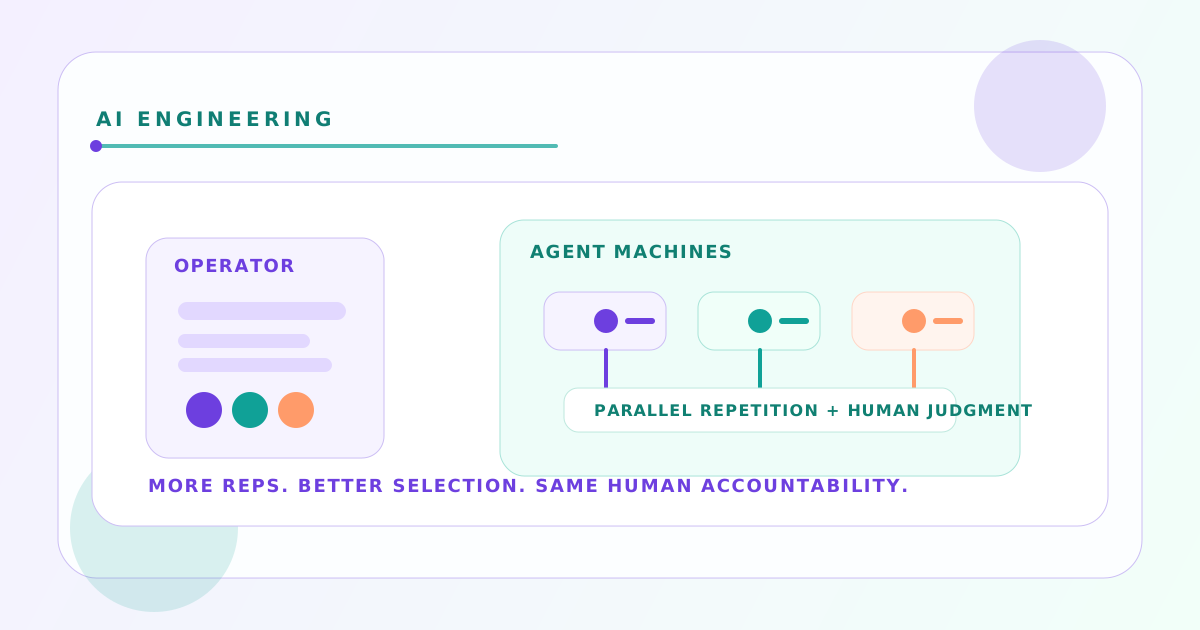
Agents change that equation because they increase the number of attempts, drafts, checks, and branches you can run without multiplying the same human effort linearly.
That means one operator can now:
- test more approaches in the same afternoon,
- run more implementation branches in parallel,
- write more specs and revisions,
- compare more outputs before deciding,
- keep progress going while attention is on another task.
That is not just smarter. It is materially harder in the sense that more total work gets done.
The important distinction is that the human is no longer personally executing every repetition. The human is managing a system that executes repetitions on demand.
The machine framing matters
If you anthropomorphize agents too much, you start managing them badly.
You forgive vagueness. You over-trust surface confidence. You assume they “understand what you mean.” You accept outputs that feel plausible instead of outputs that survive inspection.
That is the wrong mental model.
A better framing is:
- an agent is a machine with a language interface,
- the machine can perform surprisingly complex cognitive-looking operations,
- the machine is still brittle in predictable ways,
- your job is to design around those failure modes.
Once you see that clearly, the operator role sharpens.
You do not “motivate” the machine. You configure it. You do not “trust” the machine. You validate it. You do not “collaborate” with it in the human sense. You orchestrate it.
That mindset is what turns AI from novelty into durable leverage.
How AI helps you work harder
There is a boring truth here that people sometimes avoid saying because it sounds unromantic.
Machines are good because they let us do more work.
In agent systems, that shows up as:
- parallelism: multiple tasks can run at once,
- persistence: work can continue while you are looking elsewhere,
- repetition: drafts, tests, and transformations can be rerun cheaply,
- coverage: more edge cases and alternatives can be explored,
- stamina: the system does not get tired of doing the eighth variation.
This is the “harder” part.
If you are a product builder, it means you can review three onboarding flows instead of one. You can generate five instrumentation plans instead of sketching one from memory. You can run several implementation approaches, compare them, and keep only the best parts.
That increased work volume matters. It is not fake productivity if the operator is still making real decisions about quality and direction.
How AI helps you work smarter
The “smarter” part comes from better use of judgment.
Because agents can absorb some of the low-level execution burden, the operator can spend more attention on:
- problem framing,
- tradeoff evaluation,
- architecture,
- UX quality,
- prioritization,
- defining what good actually means.
This is where human skill compounds.
A weak operator with many agents can generate a lot of noise. A strong operator with many agents can generate a lot of signal.
The machine increases throughput. The human determines whether throughput becomes value.
So the smart use of AI is not just “save time.” It is “reallocate scarce human attention upward.”
The operator stack
I increasingly think good AI work looks like running a small machine floor.
You are usually responsible for five things:
- Mission: what is the actual outcome we want?
- Decomposition: what jobs exist inside that outcome?
- Routing: which agent or workflow handles which job?
- Review: what gets checked, compared, rejected, or escalated?
- Integration: what becomes the final artifact?
When those layers are explicit, agents make you both faster and sharper.
When those layers are fuzzy, agents mostly create extra motion.
That is why I like the operator framing so much. It reminds us that the leverage is real, but it also reminds us where responsibility still sits.
More reps changes ambition
One under-discussed benefit of agent systems is psychological.
When the cost of iteration drops, the size of project you are willing to attempt changes.
You stop thinking:
- “Do I have time to test this?”
- “Can I afford a second draft?”
- “Is it worth trying three structures?”
and start thinking:
- “What is the best version we can steer toward?”
- “How many paths should we compare before committing?”
- “What else becomes feasible if setup is cheap?”
That is why AI often feels like it makes ambitious people even more ambitious.
It is not just about finishing known tasks faster. It is about making larger problem spaces tractable.
The risk: fake busyness
There is still a trap here.
You can absolutely use agents to create a very persuasive illusion of productivity.
Long outputs, many branches, constant motion, impressive tool traces. None of that guarantees value.
So the operator needs a discipline:
- keep goals concrete,
- keep evaluation standards visible,
- prefer comparisons over isolated outputs,
- cut weak branches quickly,
- make quality gates explicit.
If you do not do that, you are not running a machine well. You are standing beside one while it makes noise.
My practical view
The best current use of AI is not “replace the human.”
It is “let one thoughtful human operate at a much higher throughput without giving up judgment.”
That is why I am optimistic about this moment.
It lets us increase volume and discernment together. More reps and better thinking. More attempts and better selection. Harder and smarter, at once.
But only if we are honest about what the system is.
These are not magical coworkers. They are powerful machines with cognitive interfaces. And we are the operators.
Related notes:
- From Vibe Coding to Agent Org Design
- Running a Factory for Agent Teams
- Why Technical PMs Have an Advantage Right Now
Best,
Oli
April 14, 2026