Thought of the Month (June 2026): The Steam Engine Lesson for AI
Automation has been compounding since the steam engine. AI will likely follow the same pattern: first-order labor narratives first, then harder-to-imagine layers of infrastructure, extension, and new kinds of agents.
- AI Philosophy
- Automation
- Agents
- Technology
My thought for June 2026 is that automation as we know it did not begin with AI. It has been unfolding for centuries.
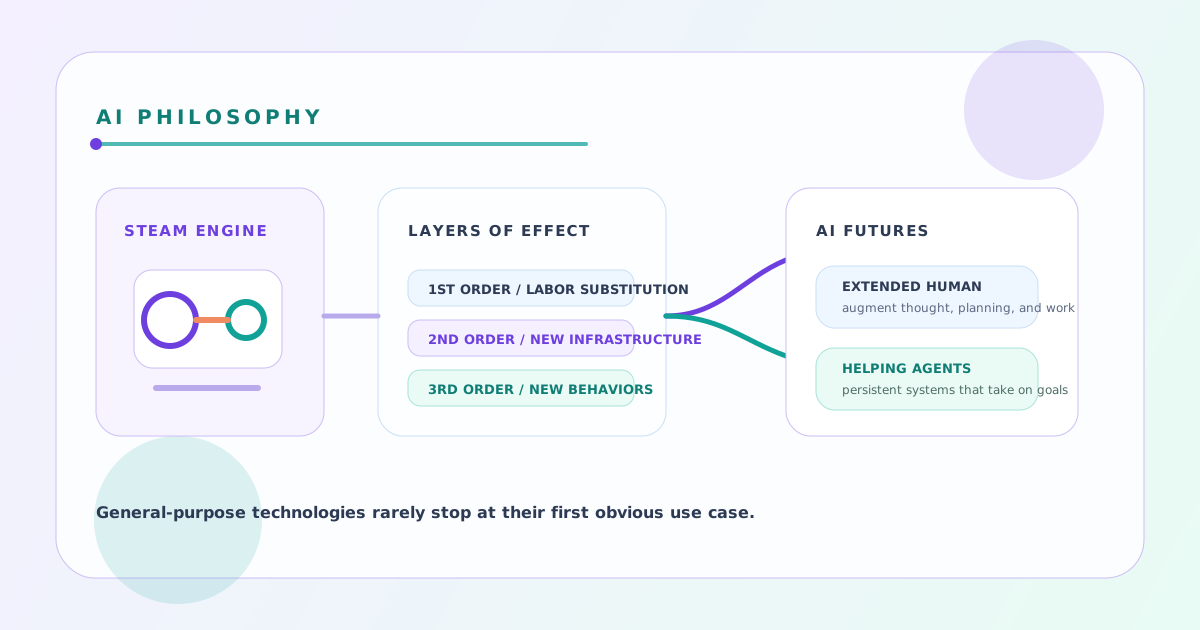
The steam engine was one of the clearest early accelerants. It did not just replace one category of labor. It changed the energy available to civilization, which changed logistics, manufacturing, transportation, urban form, and eventually whole layers of dependent technology that would have been very hard to predict at the start.
That is the frame I keep coming back to with AI.
First-order stories are usually too small
When a new general-purpose technology appears, the first stories people tell are usually direct substitution stories:
- this will replace factory labor
- this will replace horse labor
- this will replace clerical labor
- this will replace software labor
Some of that is real. But it is usually only the first layer.
People are good at imagining the first-order effect of a technology. They are much worse at imagining second-order, third-order, and fourth-order effects, especially once the technology starts combining with other systems and generating new abstractions on top of itself.
That is why early attempts to imagine the future of steam often look strange to us now. They were trying to map a new power source directly onto the old world, instead of seeing that the world itself would reorganize around it.
AI use cases today are still early
A lot of current AI discourse still feels like that early stage to me.
Many use cases are clever, but narrow. They are often framed as:
- a faster assistant
- a better search box
- a replacement for one kind of knowledge work
- a mechanical automaton for a modern office task
Again, some of that is real. But it is probably not the deepest thing happening.
The important question is not only what task AI can do today. The more important question is what new layers of coordination, cognition, production, and social structure become possible once these systems are cheap, ambient, and persistent.
The future probably spans a spectrum
My own view is that AI may develop along a spectrum with two useful poles.
On one end is the extended human model.
This is the model where AI acts as an extension of our cognitive and physical capabilities. It helps us think, model, plan, write, simulate, coordinate, and execute. In that frame, AI is less like a separate worker and more like a growing layer of externalized capability attached to a person or team.
On the other end is something closer to a helping agent model.
This is where systems become more independent, more persistent, and more goal-directed. They may spin off to handle bounded classes of work, coordinate with other systems, and solve problems related to goals they inherit or are assigned. Some of those systems may remain purely digital. Some may eventually be embodied.
I do not think the future belongs entirely to one pole or the other.
I think we are likely moving into a world where both coexist:
- systems that extend humans directly
- systems that operate beside humans as semi-autonomous helpers
What we should build for
If that is right, then the builder challenge is larger than “how do we automate this task.”
It becomes:
- What kinds of capability should remain tightly attached to a person?
- What kinds of work can safely and usefully spin out into agents?
- What infrastructure do we need to predict second-order effects before they surprise us?
- What social, product, and governance patterns help these systems compound in good directions?
That is where I think the most important work is now.
Not just making the current generation of use cases slightly better, but learning how to reason about a technology whose most important applications may still be difficult to name.
Bottom line
The steam engine lesson is that general-purpose technologies do not stop at their first obvious use case.
They create layers.
They create dependencies.
They create new behaviors.
And after a few generations, they create things that were hard to imagine from the starting point.
AI probably deserves to be thought about the same way.
Best,
Oli
June 16, 2026